
"Religions are different roads converging to the same point. What does it matter that we take different roads as long as we reach the same goal? In reality, there are as many different religions as they are individuals" Ghandhi
Religious Education (RE) is not a National Curriculum subject, but must be provided for all registered pupils in state-funded schools in England including those in the sixth form, unless withdrawn by their parents. If you wish to withdraw your child, please speak to your child's class teacher. It is a necessary part of a broad and balanced curriculum.
As RE is not nationally determined a locally agreed syllabus of RE is prepared by a local Standard Advisory Council on Religious Education (SACRE) and adopted by a local authority. It is this Hertfordshire Agreed Syllabus of Religious Education which we use as the basis of our planning and delivering of RE at Ladbrooke JMI School.
To ensure that all pupils develop knowledge and understanding of sources of wisdom and their impact whilst exploring personal and critical responses. It drives children's development and progress in becoming religiously and theologically literate.
To enable children and young people according to their ability and level of development to:
1. acquire and develop knowledge and understanding of the principal religions represented in Great Britain. These include Buddhism, Christianity, Hinduism, Islam, Judaism and Sikhism, each of which is represented in Hertfordshire;
2. develop an understanding of the influence of beliefs, values and traditions on individuals, communities, societies and cultures, including the local community;
3. develop the ability to make reasoned and informed judgements about religious and moral issues with reference to the teachings of the principal religions;
4. enhance their own development by:
- developing awareness of the fundamental questions of life arising from human experiences, and how religious beliefs and practices can relate to them;
- b) responding to the fundamental questions of life in the light of their experience and with reference to religious beliefs and practices;
- reflecting on their own beliefs, values and experiences in the light of their study;
- expressing their own personal viewpoints in a thoughtful, reasoned and considerate way.
5. recognise the right of people to hold different beliefs within an ethnically and socially diverse society.
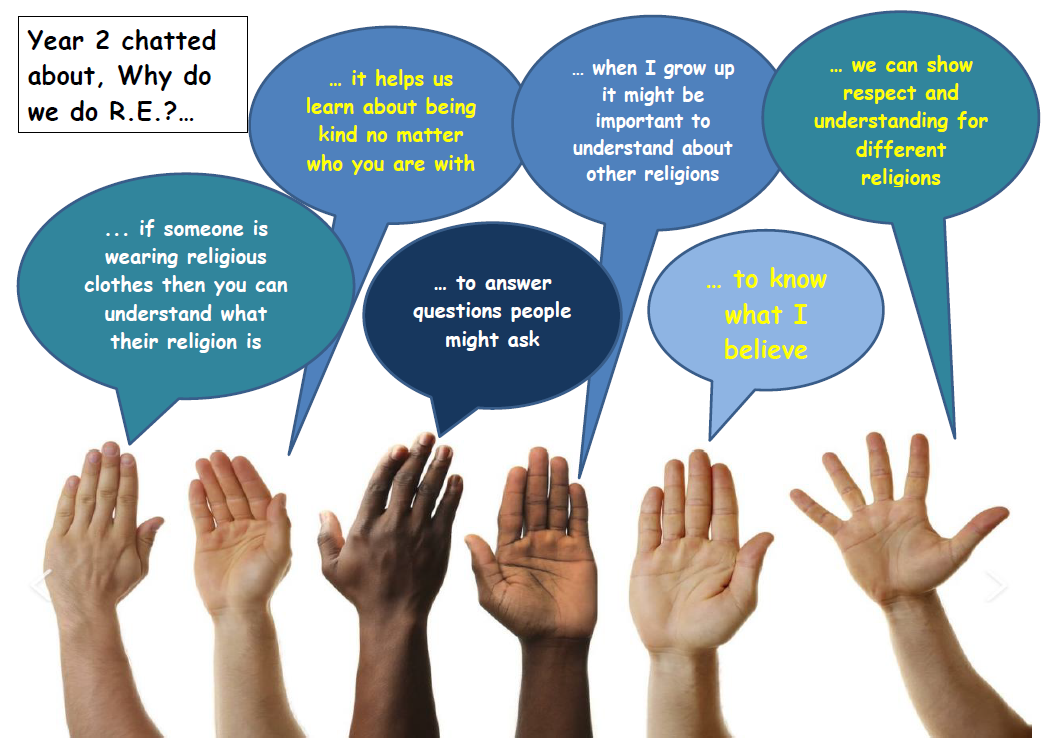
Religious Education has an important role to play in preparing pupils for adult life. It encourages pupils to develop their sense of identity and belonging. It enables them to develop individually, within their communities, as members of a diverse society and as global citizens
Religious Education enables pupils to develop respect for and sensitivity to others, in particular those whose faiths, beliefs and world views are different from their own. It promotes discernment and enables pupils to overcome prejudice.
Spiritual, Moral, Social and Cultural Development
Responsibility for the spiritual, moral, social and cultural development of pupils runs across the whole school. RE makes a significant contribution, encouraging personal reflection and development in addition to intellectual growth.
Religious Education should promote pupils':
• spiritual development through recognising and valuing their own spirituality, reflecting on and questioning their own and others’ life experiences and beliefs, understanding and appreciating the earth and the universe as sources of sustenance and inspiration;
• moral development through understanding moral dilemmas, the difference between right and wrong, consideration and concern for others, recognising personal obligations, making reasoned and informed judgements;
• social development through understanding religious communities and their activities, respecting similarities and differences, being a responsible
citizen at local, national and global levels;
• cultural development through developing a sense of belonging to and engaging with local, regional and national cultures, learning how to appreciate difference and diversity, recognising common values which cross cultures, appreciating the impact of the environment on cultural traditions.
Religious Education provokes challenging questions about the ultimate meaning and purpose of life, beliefs about God, the self and the nature of reality, issues of right and wrong and what it means to be human. It challenges pupils to reflect on, consider, analyse, interpret and evaluate issues of truth, belief, faith and ethics and to communicate their responses. It develops pupils’ awareness, knowledge and understanding of Christianity and other principal religions, religious traditions and world views.
The principal religious traditions focused on in this syllabus are, in accordance with guidance from Christianity, Hinduism, Islam, Judaism and Sikhism. If at any time we have children from other faiths in our school community, this will be taken into account when planning for religious education. Humanism and Atheism are not ‘religions’ but are world views which may be appropriate to mention
We follow the programmes of study set out in the Hertfordshire Agreed Syllabus of Religious Education. R.E. is taught weekly by class teachers. R.E. offers distinctive opportunities to promote children’s’ spiritual, moral, social and cultural development.
R.E. offers a structured and safe space with time for reflection, discussion, dialogue and debate.
There are 8 different topics taught:
- Beliefs and practices
- Sources of wisdom
- Symbols and actions
- Prayer, worship and reflection
- Identity and belonging
- Ultimate questions
- Human responsibility and values
- Justice and fairness
Each topic is revisited in greater depth as children progress through foundation stage, key stage 1, lower key stage 2 and upper key stage 2. This will support a growing sense of children’s awareness of self, their own community and their place within it.
Through the RE curriculum, we aim to develop the children's skills in Asking and Answering questions, Discussion, Research, Interviewing faith visitors, Visits to religious places, Explain findings, Making comparisons, Making links, Looking at artefacts, Writing opportunities.
In RE we like to share ideas about what we've learnt, for example...
Teachers assess learning through out lessons and attainment is reported to parents each term.